Google does not rank a page because it contains the “right” number of keywords, reaches a magic word count, or earns a perfect score in an SEO tool. It ranks results by using multiple automated systems to decide which indexed pages are most useful for a particular search, in a particular context, at a particular moment.
That distinction matters. A page can be technically healthy and still rank poorly because it answers the wrong intent. It can be comprehensive and still lose because the information is generic. It can have strong backlinks and still be a weak result for the query. Ranking is not a universal quality contest. It is a matching and prioritisation process.
The practical goal of SEO, therefore, is not to “please the algorithm” in the abstract. It is to make the right page eligible, understandable, relevant, credible, and satisfying for the searches that matter to your audience and business.
Google ranks content by interpreting the search, retrieving eligible pages from its index, and comparing signals related to relevance, quality, links, freshness, usability, and context. The weight of those signals changes with the query, so there is no single formula that guarantees a first-place ranking.
Ranking Begins After Discovery and Indexing
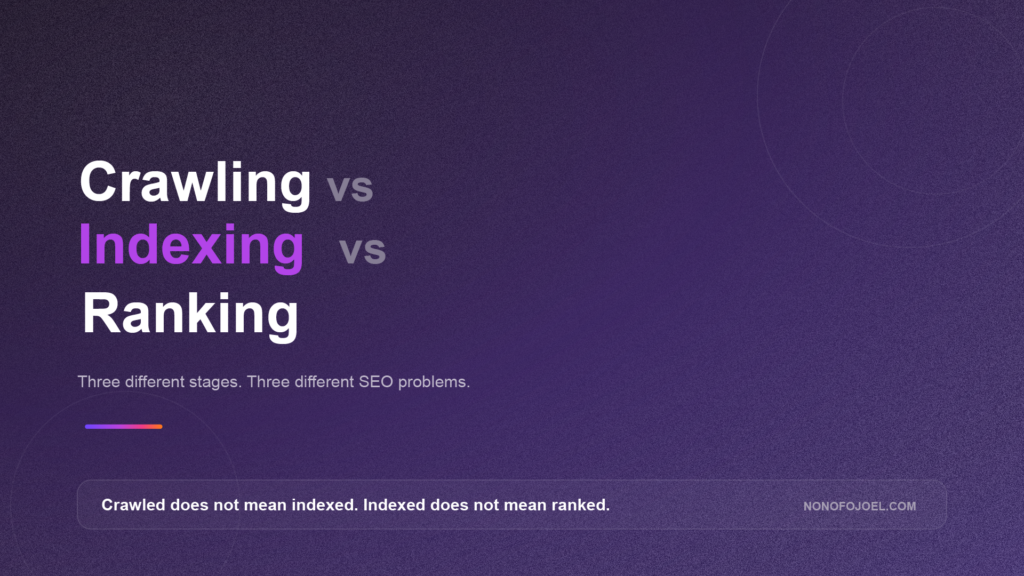
Before a page can compete in ordinary search results, Google generally needs to discover it, crawl it, understand it, and include an eligible version in its index. Ranking happens when a search is made and Google looks through that index for matching results.
This is why three problems that look similar from the outside require different remedies:
- A discovery or crawling problem means Google may not know about the URL or may not be able to fetch its content.
- An indexing problem means Google fetched the page but did not select it for inclusion, or selected another canonical version.
- A ranking problem means the page is indexed but is not being selected prominently for the queries you care about.
Publishing more copy does not fix a blocked crawler. Submitting a sitemap repeatedly does not make an indexed page more relevant. Building links to the wrong page does not correct mismatched search intent. Good diagnosis starts by identifying the stage that failed.
Google’s in-depth guide to how Search works. separates crawling, indexing, and serving results, and makes clear that ranking is programmatic rather than paid placement.
There Is No Fixed List of “The Most Important Ranking Factors”
The SEO industry often speaks about ranking factors as though Google adds points to a universal scorecard. That picture is too simple. Google uses many systems and signals, and the importance of each one depends on what the searcher is trying to accomplish.
Freshness can be decisive for a breaking news query and nearly irrelevant for the definition of a stable concept. Location is central to “coffee near me” but not to “how does canonicalisation work?” Product availability matters for a transactional search. First-hand experience can be especially valuable for travel advice, product reviews, and practical comparisons. There is no honest way to give every page the same weighting formula.
A better model is to think in layers. Each layer asks a different question, and a page can lose at any one of them.
A Practical Model of How Google Ranks Content
| Layer | Question Google must resolve | What the publisher can improve |
| 1. Eligibility | Can this page be served from the index? | Crawl access, indexability, canonical signals, mobile rendering, spam compliance |
| 2. Meaning | What does the searcher want? | Intent research, language, location, freshness needs, result format |
| 3. Relevance | Does this page answer that need? | Clear topic focus, useful coverage, descriptive titles and headings, supporting entities and examples |
| 4. Quality | Is this one of the most helpful and trustworthy options? | Original value, evidence, authorship, accuracy, reputation, references, editorial care |
| 5. Usability | Can people access and use the answer well? | Mobile experience, speed, intrusive elements, accessibility, clear main content |
| 6. Context | Is this the right result for this person and moment? | Locale, language, device, current events, query-specific expectations |
1. Google Interprets the Meaning and Intent of the Query
A search is rarely just a string of words. Google tries to understand what those words mean, how they relate to concepts, whether the user wants current information, and which type of result would satisfy the request.
Consider the query “jaguar speed.” The user might be asking about an animal or a car. “Best safari lodge” usually calls for comparisons, evidence, and location context. “Chobe National Park fees” calls for current, authoritative information. “How to get my website indexed” calls for a process and troubleshooting steps, not a sales page for an SEO package.
Google’s public ranking-systems guide describes language-understanding systems such as BERT, neural matching, and RankBrain. Their purpose is not to reward pages for mentioning those technologies. Their purpose is to connect queries with relevant concepts, even when the page does not repeat the searcher’s exact wording.
What to do: study the current results for the target query. Identify the dominant intent, but also look for an underserved need. Your page should make its purpose obvious in the title, opening, headings, and content format. Semantic breadth should come from answering the topic properly, not from stuffing synonyms into paragraphs.
2. Google Assesses Relevance Beyond Exact Keywords
Using the searcher’s language still matters. A descriptive title, a clear main heading, and natural use of the central topic help people and search systems understand the page. But relevance is not created by repetition alone.
A genuinely relevant page usually covers the concepts needed to complete the task. An article about getting indexed should explain discovery, crawl access, technical eligibility, canonicalisation, and content selection. An article about tourism SEO should address the realities of seasonal demand, location pages, direct bookings, reviews, and measurement. These supporting ideas are not “LSI keywords.” They are part of a complete answer.
Practical relevance signals include:
- a title and opening that directly answer the search need;
- headings that reflect the reader’s real subquestions;
- examples and terminology appropriate to the audience;
- the right format, such as a comparison, tutorial, definition, list, or local result;
- content that resolves adjacent questions without wandering into unrelated topics; and
- internal links that place the page inside a coherent subject area.
Keywords are inputs to editorial judgment. They are not instructions to make prose repetitive.
3. Google Looks for Helpful, Reliable, Original Value
Once several pages are relevant, usefulness and quality become the harder contest. Google’s people-first content guidance asks whether a page provides original information or analysis, covers the topic substantially, demonstrates clear authorship and expertise, and leaves the reader feeling that they have learned enough to achieve their goal.
This is where commodity content struggles. If ten articles all summarise the same sources, use the same headings, and make the same obvious observations, the eleventh version has little reason to be preferred. It may be accurate, but accuracy is only the floor.
Original value does not always require a large research study. It can come from:
- a framework that makes a complex decision easier;
- first-hand observations from doing the work;
- a useful diagnostic sequence;
- examples tailored to a specific industry or market;
- transparent comparisons that explain trade-offs;
- original data, screenshots, templates, or calculations; or
- a sharper synthesis that helps the reader act with confidence.
The advantage should not be “more words about your specific keyword.” It should be strategic clarity grounded in what you brand offers for your audience.
Use Google’s people-first content self-assessment. as an editorial review tool, especially its questions about originality, completeness, authorship, first-hand expertise, and whether readers leave satisfied.
4. Links Help Google Understand Importance, Context, and Reputation
Links remain part of Google’s core ranking systems. Google says it uses link analysis, including an evolved form of PageRank, to understand how pages relate and which may be helpful for a query. Links can also give context through the surrounding text and anchor text.
This does not mean that every link is a vote of equal value, or that acquiring the largest possible number of backlinks is a sensible strategy. Relevance, editorial context, source quality, placement, and patterns of manipulation matter. Google’s spam policies specifically address link schemes and other attempts to manufacture ranking signals.
Internal links deserve equal strategic attention. They help search engines discover pages, understand relationships, and identify which resources a site considers important. They also help readers move from a broad explanation to a more specific next step.
A useful internal-link system should:
- link every important page from at least one relevant page;
- use descriptive anchor text rather than “click here”;
- connect pillar pages to supporting articles and supporting articles back to the pillar;
- place links where they genuinely help the reader continue; and
- avoid bloated sitewide link blocks that flatten the meaning of the architecture.
Google’s link best-practices documentation confirms that links are used for discovery and relevance, and recommends crawlable HTML links with concise, contextual anchor text.
5. Freshness Matters When the Query Demands It
Freshness is not a blanket instruction to update every article every week. Google has systems designed to surface newer information when a query deserves freshness. A search about today’s exchange rate, a recent algorithm update, current entry requirements, or live event dates has a stronger freshness requirement than a search for a stable definition.
The right question is not “How often should we change the date?” It is “What information could make this page inaccurate, incomplete, or less useful over time?” Update those elements, add meaningful new value, and show an accurate publication or modification date. Changing a timestamp without substantially updating the page is not a content strategy.
6. Page Experience Can Help, but It Cannot Rescue the Wrong Answer
A page should work well on mobile devices, load reliably, use secure delivery, avoid intrusive interruptions, and make the main content easy to distinguish. These improvements matter for people and can contribute to Search performance.
But page experience is not a substitute for relevance. Google explicitly says there is no single page-experience signal, and a perfect Core Web Vitals report does not guarantee a top ranking. When many pages are similarly helpful and relevant, a better experience may help one perform more strongly. When the content misses the intent, speed alone will not save it.
Google’s page-experience guidance. recommends evaluating the overall experience rather than chasing one isolated score.
7. Context Changes Which Result Is Best
Ranking is contextual. Language, location, device, settings, and current events can affect which results are useful. Two people can search the same phrase and reasonably see different results because the underlying need is not identical.
This is especially important for tourism, hospitality, and local businesses. A generic global article may be less useful than a clear local page with accurate location details, current availability, strong images, reviews, policies, and direct booking information. Local relevance is not created by inserting a city name repeatedly. It comes from being genuinely useful for someone making a decision in that place.
8. Google Applies Diversity, Deduplication, and Spam Systems
Search results are not simply the highest scores in descending order. Google also uses systems for deduplication, site diversity, original content, spam detection, and specialised result types. Two near-identical pages from the same website may compete for the same intent, while Google may select one canonical version and suppress the rest.
This is why publishing many slight variations of one article is usually weaker than building one definitive resource and a set of genuinely distinct supporting pages. It also explains why keyword cannibalisation is often an architecture and intent problem, not something solved by changing a few headings.
Google’s spam policies also warn against scaled content created primarily to manipulate rankings, regardless of whether automation, generative AI, scraping, or manual production was used. The problem is not the tool. The problem is producing large amounts of unoriginal content with little value for users.
Review the current Google Search spam policies. before using link acquisition, automation, expired domains, third-party content, or high-volume publishing tactics.
PageRank Is Not the Same as Your Page’s Ranking Position
The terms are easy to confuse. PageRank is a link-analysis concept and remains part of Google’s core systems in an evolved form. A page’s ranking position is where it appears for a particular query. The two are not interchangeable.
A page can attract strong links and still rank poorly for a query if it is not relevant, current, accessible, or useful enough. A lower-authority page can sometimes outrank a stronger domain when it is a much better match for a specific search. Links matter, but they operate inside a broader system.
Third-party metrics such as Domain Authority, Domain Rating, and similar scores can be useful comparative estimates. They are not Google metrics and should not be presented as direct inputs to Google’s ranking systems.
What E-E-A-T Does and Does Not Mean
Experience, expertise, authoritativeness, and trustworthiness are useful concepts for evaluating content quality. They are especially important when poor information could affect someone’s health, finances, safety, or wellbeing.
However, E-E-A-T should not be treated as a public numeric score that can be increased by adding an author box and declaring someone an expert. Search quality raters use published guidelines to assess whether Google’s systems are producing good results. Their ratings do not directly determine the position of an individual page. Google uses the feedback to evaluate and improve systems at scale.
The practical application is straightforward: make authorship clear, support claims, show relevant experience, cite reliable sources, correct errors, maintain accurate business information, and give readers a reason to trust the page. Do these things because they improve the content and the decision it supports, not because you are trying to manufacture an E-E-A-T score.
A Seven-Step Framework for Creating Content That Can Rank
- Start with the business and audience need. Choose topics where useful search demand overlaps with genuine expertise, a clear audience problem, and a meaningful next step for the business. Traffic without strategic fit creates activity, not growth.
- Define the search intent before drafting. Review the results, formats, freshness requirements, and recurring subquestions. Decide what the searcher is trying to learn, compare, find, or do.
- Choose a distinct promise. Do not merely reproduce the current results. Decide what will make the page more useful: a stronger framework, better examples, clearer diagnosis, original evidence, local context, or more honest trade-offs.
- Build the answer in layers. Answer the core question early, then cover the supporting questions in a logical sequence. Use descriptive headings, examples, and definitions that make important ideas easy to understand and extract.
- Prove the page deserves trust. Use accurate authorship, first-hand experience where available, reliable external sources, transparent methods, and careful editing. Remove claims you cannot support.
- Connect and promote the page. Add relevant internal links, make the URL reachable through the site architecture, and earn attention through relationships, distribution, partnerships, and genuinely useful assets. Avoid manipulative link schemes.
- Measure and improve the right layer. Use Search Console to understand queries, impressions, clicks, click-through rate, and position trends. Use analytics to understand what people do after the click. Diagnose whether the issue is eligibility, relevance, presentation, demand, or conversion before changing the page.
How to Diagnose a Page That Is Not Ranking
When performance is weak, work through the evidence in order. Do not begin with a random rewrite.
| Evidence | Likely issue | Next check |
| URL is not indexed | Discovery, access, canonicalisation, quality, or eligibility | URL Inspection, Page Indexing report, rendered page, canonical signals |
| Indexed, almost no impressions | Weak topic demand, poor query match, or insufficient relevance/quality | Target query, current SERP, page purpose, internal links, competing URLs |
| Impressions rising, position low | Google sees some relevance but stronger results exist | Intent match, originality, evidence, coverage gaps, reputation, links |
| Position stable, CTR weak | Search appearance or promise is uncompetitive | Title link, snippet, result type, brand recognition, query-page alignment |
| Clicks arrive, conversions weak | The ranking is not the primary problem | Offer, page UX, CTA, trust, speed, analytics events, audience fit |
| Sudden sitewide drop | Technical change, policy issue, algorithmic shift, seasonality, or demand change | Search Console, release log, manual actions, security issues, Google Trends |
Search Console tells you what happened before the visit: impressions, clicks, queries, click-through rate, and average position. Analytics tells you what happened after the visit: engagement, journeys, enquiries, sales, and other outcomes. Use both. A ranking improvement that attracts the wrong audience is not necessarily a business improvement.
Google’s guide to using Search Console and Google Analytics together. explains why the tools measure different parts of the journey and why their numbers will not match exactly.
Seven Ranking Myths Worth Retiring
“There is an ideal keyword density.”
No public Google guidance gives publishers a target percentage. Use the language needed to answer clearly. Repetition that makes the page unnatural is a warning, not an advantage.
“Longer content ranks better.”
Length can be a by-product of completeness, but Google does not prescribe a preferred word count. The right length is the amount required to satisfy the intent without padding.
“A perfect Core Web Vitals score guarantees rankings.”
Core Web Vitals and overall experience matter, but they do not override relevance and usefulness. Optimise them for users, not as a promise of first place.
“Domain Authority is a Google ranking score.”
It is a third-party estimate. It can support competitive analysis, but Google does not use that proprietary metric.
“Exact-match domains automatically rank.”
Google has a system intended to avoid giving excessive credit to domains created simply to match a query. A descriptive domain is not a substitute for useful content and a credible brand.
“Search quality raters manually rank websites.”
Raters evaluate result quality and help Google test systems. Their ratings do not directly set an individual page’s position.
“You can pay Google for better organic rankings.”
Paid advertisements are separate from organic results. Google states that it does not accept payment to rank a page higher in organic Search.
Frequently Asked Questions
How does Google rank search results?
Google interprets the query, retrieves eligible pages from its index, and uses multiple systems and signals to assess relevance, quality, links, freshness, usability, and context. The weighting changes depending on the search.
What are the most important Google ranking factors?
There is no universal ordered list. Relevance to the query and genuinely helpful, reliable content are foundational. Links, freshness, page experience, location, and other signals matter differently across queries.
Does Google still use PageRank?
Yes. Google’s ranking-systems guide says PageRank remains part of its core ranking systems, although it has evolved considerably since the original version.
Do backlinks improve rankings?
Relevant, editorially earned links can help Google understand pages and assess which may be useful. The effect is not a simple link count, and manipulative link schemes can violate spam policies.
Is content length a ranking factor?
Google does not recommend a preferred word count. Content should be long enough to satisfy the reader’s need and no longer than necessary to do that well.
How long does it take a page to rank?
There is no guaranteed timeframe. Discovery, indexing, competition, demand, site reputation, links, freshness, and the strength of the page all affect how performance develops. Measure trends over meaningful periods rather than expecting an immediate result.
Is E-E-A-T a ranking factor?
E-E-A-T is best understood as a quality framework, not a public numeric score. Google says its systems use signals that align with these qualities, while search quality rater scores do not directly rank individual pages.
Build the Best Result, Not the Most Optimised-Looking Page
The most productive way to think about Google rankings is as a sequence of decisions.
- Can the page be served?
- Does it match the search?
- Is it more useful and trustworthy than the alternatives?
- Can people access and use it well?
- Does it make sense for this location, language, and moment?
This model is less seductive than a checklist of secret factors, but it is far more useful. It directs teams towards better diagnosis, stronger content, clearer architecture, credible promotion, and a better experience after the click.
If a page is not performing, do not ask only, “Which ranking factor are we missing?” Ask, “At which stage are we losing, and what evidence would prove it?”
That question turns SEO from superstition into a system.